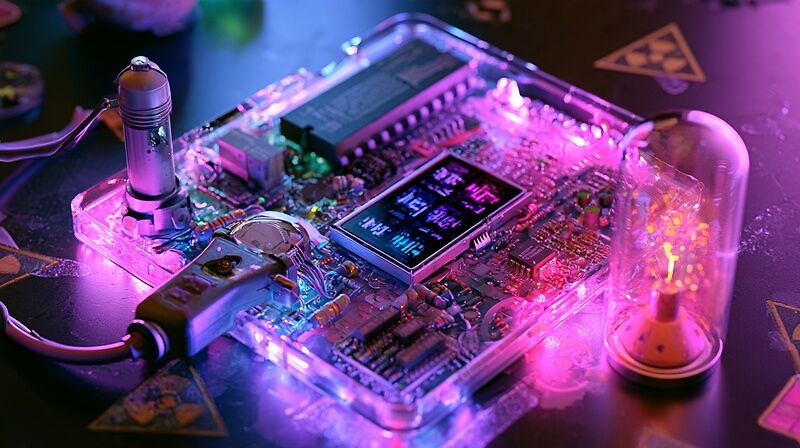
In September 2026, developer Alexander Higgins introduced Entropy32 Plus — an open-source project that uses radioactive decay to generate Bitcoin seed phrases. The device, called "The Universe Bifurcator," turns the unpredictability of quantum processes into cryptographic keys, offering a radically new approach to entropy generation. The project includes firmware, PCB schematics, manufacturing files and 3D enclosure models, but the developer warns that it is an experimental system that has not undergone independent validation.
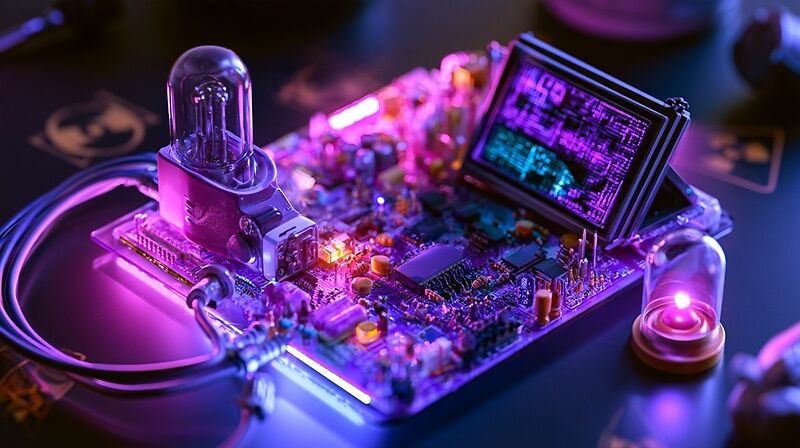
Radioactive decay occurs unpredictably at the level of individual atoms — a fundamental property of quantum mechanics. Entropy32 Plus uses this unpredictability instead of software-based random number generators. The device receives pulses through a 3.5 mm connection from a GQ Electronics GMC-320S Geiger counter, which can detect radiation from a radioactive source or background radiation.
After receiving a pulse, an LM393 comparator converts the counter's analog signal into a digital input. A dedicated printed circuit board passes this signal to an ATmega328P microcontroller. The firmware records each accepted event using a microsecond timer and compares the latest interval with the previous one, generating a one if the new interval is longer and a zero if it is shorter. Equal intervals are discarded. Measurements below 200 microseconds are rejected as possible glitches, and accepted comparisons continue until 512 bits have been collected.
This method uses pulse timing because the exact arrival time of an individual decay event cannot be predicted. The developer does not claim that each collected comparison contributes one full bit of measured entropy. The system collects twice as many comparison bits as the maximum 256-bit BIP39 input it produces. Until the physical source is formally measured, the repository does not establish how much useful entropy each comparison contains.
Once the 512-bit pool is complete, Entropy32 Plus processes all 64 bytes through its built-in SHA-256 code. The firmware uses the first 16 bytes of the resulting hash for a 12-word phrase or all 32 bytes for a 24-word phrase. Hash conditioning is intended to reduce visible patterns associated with detector dead time, changes in count rate or correlations between measurements. Hash conditioning can distribute available entropy across the output, but it does not prove how much unpredictability was present in the raw data.
The firmware includes a startup test for SHA-256. It calculates the hash of the string "abc" and compares the result with the known value. The device stops before collecting entropy if the output is incorrect. Passing the self-test confirms that the implementation returns the expected result for that test vector, but it does not test the Geiger counter, assess pulse independence or measure the minimum entropy entering the hash.
After SHA-256 conditioning, the device applies the process defined by the BIP39 specification. For a 12-word phrase, Entropy32 Plus uses 128 bits of conditioned data and calculates a four-bit checksum. The combined 132 bits are divided into twelve 11-bit groups, each selecting one word from the standardized list of 2,048 words. The 24-word configuration uses 256 bits and an eight-bit checksum, dividing the resulting 264-bit sequence into 24 word indices. The full English BIP39 word list is compiled into the firmware and occupies 13,117 bytes — around 43% of the microcontroller's flash capacity.
The published hardware files contain no wireless communication components. Users operate the generator with two buttons and read the phrase from a 0.91-inch OLED display. The generated word indices temporarily remain in the microcontroller's RAM. After the user writes down the phrase, pressing both buttons opens a confirmation process that overwrites the word array and restarts entropy collection. The firmware clears the original pool after copying it for processing. Temporary hash, checksum and entropy buffers are overwritten after the BIP39 indices are calculated.
According to the developer, the device does not store the recovery phrase in persistent memory. The open-source design does not include a secure element or a mechanism proving that the installed firmware matches the public code. Physical isolation eliminates several network attack vectors, but it does not verify that the device was assembled correctly or loaded with trusted software. A modified unit could display predetermined words or store generated data without changing its external appearance.
Wallet security guidance recommends keeping recovery phrases away from phones, cloud accounts, photographs and other connected systems. The screen-based Entropy32 Plus process is compatible with offline transcription as long as the hardware and software are trusted. However, the absence of a secure element means that users must fully trust the integrity of the device and the correctness of its assembly.
The repository states that the Geiger-counter-based entropy source has not been tested under NIST Special Publication 800-90B. The NIST methodology covers the evaluation of physical entropy sources and includes separate procedures for independent and dependent data. Higgins encourages recording raw inter-arrival times over an extended period and examining them using NIST minimum-entropy estimators for non-IID data. Comments in the firmware warn that general statistical test results alone are not sufficient to establish adequate entropy.
"Please test the entropy source you intend to use, otherwise understand that you will be using the device at your own risk," the README states. The developer recommends mixing data obtained from the Geiger counter with another independently validated source before creating a wallet for valuable funds. As of September 13, the repository did not include an external audit, a NIST assessment or a public dataset of raw events.
Past wallet failures show why entropy testing goes beyond confirming that the final words comply with BIP39 formatting. Kraken's head of security called for independent wallet testing after a seed-generation vulnerability in Coldcard. A related technical review explained how weak entropy can expose Bitcoin wallets without revealing which individuals use the affected devices. Attackers can generate possible seeds, derive their public addresses and search for matches on the blockchain.
Predictable seed generation remained exploitable even after the underlying flaw had existed for years. Fixing faulty firmware cannot restore phrases that were generated earlier; affected users must create new wallets and move their assets. Entropy32 Plus remains under active development. The commit history shows an initial commit dated September 4, followed by changes to the firmware, printed circuit board and enclosure. As of September 13, the repository had no tagged production release or published schedule for completing an independent security assessment.
The Entropy32 Plus project represents an interesting approach to solving the fundamental problem of generating true randomness in cryptography. Using the quantum processes of radioactive decay theoretically provides a higher degree of unpredictability than pseudorandom generators. However, the lack of formal validation, independent auditing and certification creates significant risks for users who may underestimate the complexity of correctly implementing cryptographic systems.
The history of cryptography is full of examples where elegant theoretical concepts proved vulnerable in practice because of subtle implementation errors, side-channel attacks or insufficient entropy. The project's open-source nature allows the community to examine the code and hardware design, but this does not replace formal certification and long-term testing under real-world conditions. For mainstream use, such solutions need to go through rigorous evaluation processes similar to those applied to commercial hardware wallets.
Nevertheless, Entropy32 Plus demonstrates the healthy innovative spirit of the crypto community and its pursuit of maximum decentralization and transparency across every aspect of security. The project serves as a reminder that security is not a static property, but a continuous process requiring constant verification, auditing and improvement. In a world where the cost of mistakes is measured in millions of dollars, experimental approaches should remain within the realm of research and education until they reach sufficient maturity and reliability.
“Cryptography is the art of turning secrets into mathematics. But even the most perfect mathematics is useless without true randomness at its foundation.”
— Bruce Schneier, cryptographer and security expert