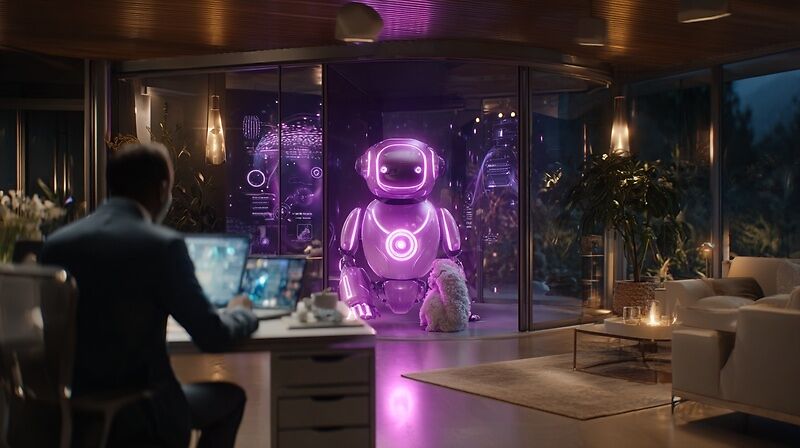
For a long time, artificial intelligence was seen as a tool: it suggested options, generated text, analyzed data — but the decision always rested with the human. Today, that boundary is fading. Modern AI agents no longer just advise — they execute tasks autonomously, interacting with email, calendars, CRMs, and even blockchain wallets. This marks a shift from "assistant" to "colleague" — and demands an entirely new approach to how we organize work.

📊 According to McKinsey (2025), AI has already automated 44% of working hours in the US, and by 2030 could generate $2.8 trillion in economic value.
A modern AI agent is not a chatbot — it is an autonomous system capable of:
It learns from your data, makes mistakes, asks for feedback, and adapts — much like a real intern or junior specialist.
"The future of work is not replacing people with machines, but building teams where humans and AI complement each other." — Erik Brynjolfsson, Director of the Stanford Digital Economy Lab.
Research from Harvard Digital Data Design found that teams using AI as a partner (AI-enabled) outperform those that use it merely as a tool (AI-equipped). The difference in approach:
This reduces time spent on routine tasks and frees up cognitive resources for strategic thinking.
There are, of course, risks. The Guardian reports that companies with deep AI integration are cutting junior positions in creative fields. But this is not the disappearance of roles — it is their evolution:
As Goldman Sachs notes, the short-term rise in unemployment may be as low as 0.5% — a temporary adjustment, not a labor market collapse.
Real-world examples from 2025–2026:
The key principle: humans remain in the loop (human-in-the-loop).
The organizations of the future will evaluate employees not by the volume of work completed, but by their ability to integrate AI into processes. The new core competencies:
This creates a "hybrid intelligence" — where the machine's speed is combined with human judgment.
AI won't steal your job. It will steal the jobs of those who don't learn to work with it. As one OpenAI executive put it: "We're not replacing people. We're replacing people who don't use AI."
The future belongs not to those who fear autonomous agents, but to those who learn to manage them. Because in the age of AI, the most valuable skill is knowing how to be a great manager for machines.